What Actually Slows a Ballston Lake Closing (And How to Get Ahead of It)
August 20, 2026
August 20, 2026
Ask a Ballston Lake seller what worries them about closing and most say the same thing: the buyer's financing, or the inspection turning up something in the crawlspace. Almost nobody names the actual culprit. The paperwork now has to agree with a public record that used to sit quietly on a lake association's website, and most sellers don't find out the two don't match until their attorney is on the phone with the buyer's attorney a week before closing.
That's the real story behind waterfront closings on this lake right now. Not bad faith, not hidden defects. A disclosure law that changed in 2024, a lake with an unusually well-documented flood and water-level history, and a handful of permits that either exist on file or don't. When those three things don't line up cleanly, closings stretch by weeks instead of days.
For two decades, New York sellers had an escape hatch. If you didn't want to answer the state's Property Condition Disclosure Statement, you could hand the buyer a $500 credit at closing instead and skip the form entirely. Most sellers' attorneys advised exactly that, since the questions carried real liability and the credit was cheap insurance against a lawsuit.
That option is gone. Governor Hochul signed an amendment in September 2023 that took effect March 20, 2024, and it did two things. It eliminated the $500 credit as an alternative to disclosure. And it added seven new questions specifically about flood history, flood insurance, and FEMA flood zone status, on top of a mold-history question added the year before. Every seller of a one-to-four-family home in New York now has to answer these questions in writing, based on actual knowledge, before a buyer signs a contract.
For a home on a quiet cul-de-sac, that's a paperwork change. For a home on Ballston Lake, it's a different conversation entirely, because the flood question isn't hypothetical here.
| Before March 20, 2024 | After March 20, 2024 | |
|---|---|---|
| Flood disclosure | Not required | Seven required questions on flood zone, flood insurance, and flood claims |
| Escape option | $500 credit in lieu of disclosure | No longer available |
| Seller liability | Limited to willful misrepresentation | Same standard, but now applies to flood answers too |
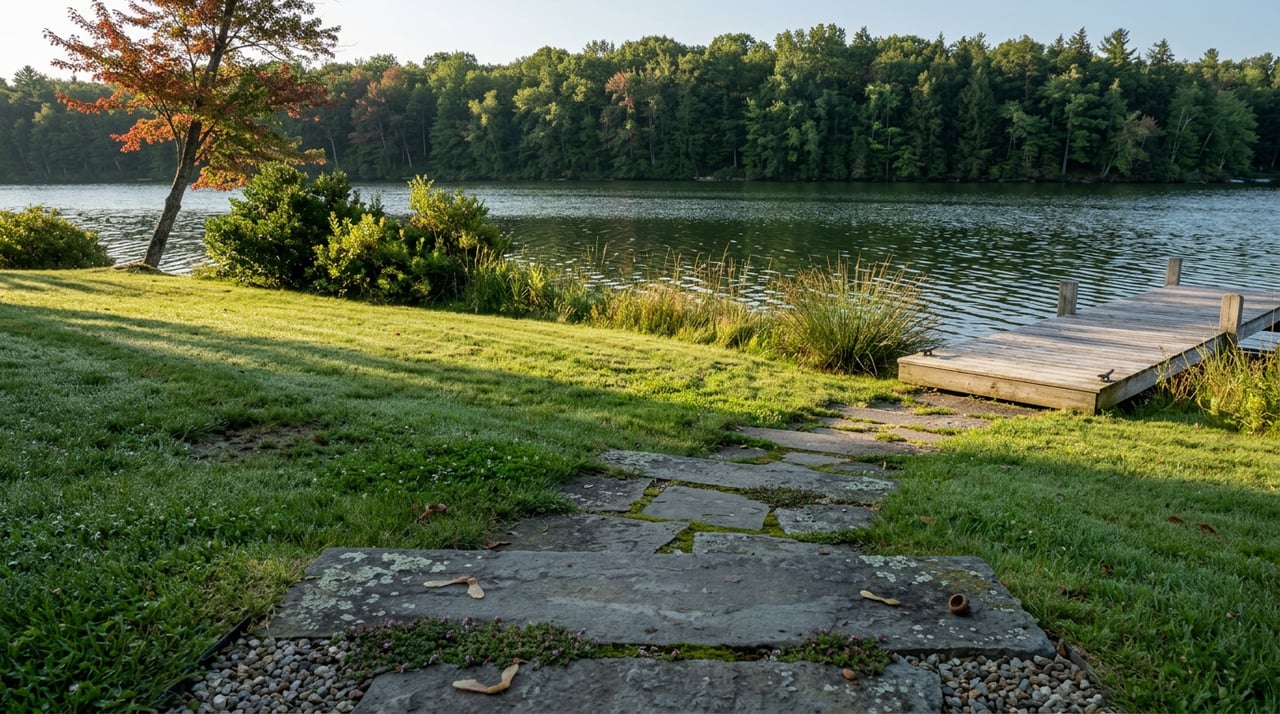
Here's what makes Ballston Lake different from a generic New York flood disclosure story. The Ballston Lake Improvement Association keeps its own public record of the lake's water behavior, and that record doesn't disappear just because a seller checks "no" on a form.
As of August 2023, the lake had been above flood stage for 151 of the previous 365 days, or 42 percent of the year, according to BLIA's own posted data. The association's most recent newsletter reports 42 trips to Outlet Creek last year as part of ongoing lake-level management, and a new water use restriction took effect May 25, 2026, according to the Town of Ballston. This isn't a lake where flood risk is an abstract FEMA map exercise. It's an active, managed condition that a nonprofit lake association documents in writing every year.
Ballston Lake is also meromictic, meaning its deep water never mixes with the surface layer, and it runs up to 110 feet deep at the south end. That depth and structure are part of what makes the lake a genuine amenity. They're also part of why water level and flood behavior here get more attention than on a shallow, uniform pond.
None of this means a seller has to disclose more than they actually know. The PCDA still only requires answers based on actual knowledge, not an investigation. But "actual knowledge" gets harder to argue when the relevant facts are sitting on a public association website with your street a few hundred yards from the data point. A buyer's attorney who spends ten minutes on BLIA's site before closing will ask why the seller's flood answers don't mention any of it.
Waterfront living on this lake usually comes with a dock, a mooring, or a boathouse, and all three fall under a Town of Ballston ordinance that has been in effect since June 1, 2007. The ordinance requires a permit for docks, moorings, and boathouses on Ballston Lake, which means any structure built or substantially modified after that date should have paperwork behind it.
This becomes a closing issue in a specific way. Buyers' attorneys increasingly ask for permit documentation on waterfront structures as a matter of course, not because they suspect anything, but because it's become standard due diligence on lake properties statewide. A seller who inherited a dock built decades ago, or who added a boathouse without pulling a permit, often doesn't think to check until the request lands during attorney review. Tracking down permit history at that point adds real time to a transaction that otherwise had nothing wrong with it.
The fix is simple and doesn't require a lawyer to explain: know what's on file with the town before you list, not after an attorney asks.
The other place lakefront closings quietly stall is underground. Many homes on Ballston Lake were built before current setback rules for septic systems from wells, property lines, and water bodies existed, which means an older system that has functioned fine for decades can still fail a modern inspection on setback grounds alone, independent of whether it's actually leaking.
A local Saratoga County excavating contractor that handles these replacements regularly puts the timeline at 2 to 4 weeks just for permitting, once the paperwork is complete and meets all requirements, before any excavation starts. Installation itself typically runs 3 to 5 days of physical work, but frozen ground and scheduling can stretch that further. Add it up and a septic issue discovered during a fall inspection can push a closing well into the following month.
New York doesn't universally require private well testing before a sale, but FHA, VA, and USDA loan programs frequently do require it when a home is served by a private well, according to well water testing resources serving the Saratoga region. Since a meaningful share of lakefront buyers finance through one of those programs, a seller who assumes "New York doesn't require it" can still get a testing request mid-contract that they didn't budget time for.
None of this means waterfront homes on Ballston Lake are harder to sell. It means the friction points are specific and predictable, and a seller who checks them before listing avoids the version of this story where everything stalls two weeks before the closing table.
The pattern across all three issues is the same. The paperwork requirement isn't new anymore, and the lake's own public record isn't hidden. What catches sellers off guard is the gap between what they assumed they didn't have to document and what a buyer's attorney now expects to see as standard practice on a documented, actively managed lake. Closing this gap before a home goes on the market is the difference between a clean 45-day contract and one that drags into its third month over paperwork that could have been gathered in an afternoon.
Does the new flood disclosure requirement apply if my home isn't directly on the water? Yes. The PCDA's flood questions apply to all one-to-four-family residential sales statewide, not just waterfront parcels. Homes near Ballston Lake but set back from the shoreline still answer the same seven questions.
Do I have to test my well before I can list my home? New York doesn't universally mandate it for conventional sales, but FHA, VA, and USDA-financed buyers commonly require water testing as a condition of their loan. Testing ahead of listing means you already have the answer when a buyer's lender asks.
What if I don't know whether my dock has a permit on file? The Town of Ballston's dock, mooring, and boathouse ordinance has governed structures on the lake since June 1, 2007. If your dock predates that or you're unsure of its permit history, it's worth checking with the town before a buyer's attorney asks during contract.
If you're weighing a sale on Ballston Lake and want to know exactly which of these items apply to your specific property before a buyer's attorney finds them first, the Shayna Goodson Team can walk through your disclosure form, dock history, and septic setback status in a single conversation. Get Your Free Home Valuation and start with a clear picture of what your closing actually requires.
Stay up to date on the latest real estate trends.



Dedicated to both technology and innovation, The Shayna Goodson Team comprises a group of highly specialized real estate professionals who are poised to provide you with tailored solutions to achieve your objectives, whether you're in the market to buy or sell. Our team is known for its unwavering commitment and determination, aiming to become your lifelong, trusted partners in real estate expertise.